Wednesday, August 13, 2014

Something is drawing me to drawing


The weather in western Germany hasn’t been nice during those past weeks, or at least not reliable with some heavy thunderstorms. I have to admit that I like it. I like thunder, lightning, rain. Especially, when I am at home, snugly, with a blanket and some tea.
For ages I wanted to rediscover an old hobby of mine: drawing. When I was at school I often used pencils
 to draw portraits.
I have to say, that I almost never drew from scratch, but copied photographs.


When you draw, everything around you vanishes, you concentrate on the next line, which pencil to use for which part of the portrait, the delicate lines underneath the eye of the person, their nose (always tricky) and their special features. Funnily enough, even when I had the most amazing sitting, drawing for hours and hours, I am never satisfied with the result. Often the portrait looks alright in the beginning and then I start to get impatient and rush over the hair, e.g. You can see it in the one picture I have drawn so far, it is a French actress, I cannot recall the name, but this 1960s portrait of her is so pretty, I love it.


I like the concentration that lies in her whole posture and the melancholy expressed by her eyes.

A tricky thing when you begin to draw a portrait is always proportions. First of all I try to sketch the whole head in very fine lines to decide where the nose has to be, how big it is compared to the mouth, etc. you know what I mean. In the fist picture you can see those lines if you look closely. I loved the drawing of the hands. It was not particularly easy, but the good thing if you are copying black and white portraits is, you just have to draw what is ACTUALLY THERE. Now, that might sound easier, than it is, but it is, in fact, easy. So if you apply line by line, hands appear out of nowhere. It was great fun.


The nose gave me some trouble, I made it too long. The eyes are still a weak point of the portrait and I am still not satisfied by it. Worst part is the hair. I was impatient and it is not easy to draw it, so I rushed over it.


Nonetheless, it was great fun and I hope to have more time for practicing my drawing skills in the next months. (Maybe even the next week, as I am doing a one-woman-travel-experience to Berlin, wohoooo! Tons of people to meet, though, so cross your fingers that I will find some time.)


Tuesday, July 8, 2014

Bouldering, what a joy!


Hey folks, what have you been up to these last months? It has been an amazing time for me with a lot of
short trips, weddings, parties and a lot of work, which is why I am looking forward to my holiday in Mallorca starting this Saturday. Friends of mine have been there for a climbing holiday and this is exciting me even more, as Mr. Schön and me have been discovering climbing as a new passion. Or let’s be more specific: bouldering. For those who have never heard of it before, it basically means climbing without the use of ropes or harnesses, only with either water underneath, or more common bouldering mats, crashpads, or in halls just very soft floors you can fall onto. You do not boulder in heights people reach when climbing, roughly four meters is the maximum, in order to give you the possibility to jump when you lose your strength.

I am afraid of height, I even hate crossing bridges sometimes and being in a crag in Cologne last year made me freak out, so you can imagine that it was not my dearest wish to try out bouldering. I have been climbing, with the harness and this kind of stuff, but I never really enjoyed it. Especially not the part about sitting back in the harness and coming down again. But when I heard that a friend of ours who suffers even more from vertigo than me is coming I felt like a wuss not to go too. We went to a great bouldering hall in Dortmund, a new, huge one, with all kinds of problems (the path a climber takes is called a “problem”. Fitting if you ask me. You can see the problems easily, they are all of one colour.) The climbing walls were about four meters high and when you reached the end of your path you could climb on top and just sit there or walk to an easy ladder-like path to climb down again. I loved the hall, the people who helped one another and how easy bouldering actually was for me. My legs and feet are pretty strong from running, so the straight and leaning-towards-the-wall kind of problems were cool to climb.


There was some horizontal climbing which was a lot of fun, too, as height was not much of a problem here. Almost all of our group were newbies, but whenever we had difficulties with a path, someone gave us good advice. Most of the time it was something like “Try to place your right hand here instead of your left hand” and you know what? It worked! I was impressed at seeing how much skill in bouldering derives from tactics and not so much from strength. It was good that difficult and easy problems were mixed in the hall, in order to also mix experienced with non-experienced climbers. Even my friend with the huge fear of heights got over her fear and climbed fairly high. I think that day was kind of a triumph for her and it was great for the atmosphere in the team. After two hours though, my arms and shoulders were pretty weak, so bouldering a day is out of the question at the moment. It is great though to just sit and watch people solving the most difficult problems. I have seen people do things that I would have thought are impossible.


After our experience in Dortmund we searched for halls nearby, and found a hall in Düsseldorf, which sadly is not nearly as impressive as the new hall in Dortmund. It is a) much smaller and b) not as well equipped for beginners as the one in Dortmund. There are a lot of problems including overhanging surfaces where you have to rely heavily on the strength of your arms and shoulders. As mentioned above I have some work to do in that area and was therefore kind of frustrated by the hall in Düsseldorf. They have some interesting and challenging problems for beginners however and we will definitely go again soon and maybe get some climbing shoes on our own. Maybe we will even have the chance to try some Deep Water Solo, as the climbing water is called in Mallorca. Try it, and tell me about your experience!


This video gives you a good impression of what bouldering is, much more impressive than a video of our feeble first moves:

Tuesday, April 8, 2014

Delicious sugar-free Mousse au Chocolat


Being the sweet tooth that I am, I could not resist temptation and searched for sweet alternatives. Xylit seems to be one of the cheapest and healthiest alternatives to sugar, which is even good for your teeth. It tastes quite similar to sugar and doesn’t have a weird aftertaste like stevia. At amazon you can get 1 kg of xylit for 10 Euros. Compared to sugar that is a huge difference, but I would say it is worth it. Xylit is also called wood-sugar, as it is made out of tree barks. It has much less calories than industrial sugar and it does not rise your blood sugar levels. (http://en.wikipedia.org/wiki/Xylitol)


Last weekend we tried a recipe with xylit. It was also lactose-free, but instead of soycream we used regular cream. You can try it with soy cream, I bet it will still be delicious. Not being too fond of mousse au chocolat myself, I still know how much my better half enjoys it, which is why our first xylit-dessert came to be mousse au chocolat. We loved the coconut fat, and I found quite different opinions on it in the net. They all agree that coconut fat has lots of saturated fat, but there are hints that these saturated fats act differently from others… Hm. I can say it is delicious, as it adds some coconutty flavour to the mousse au chocolat, it was so tasty. The good thing about organic coconut fat, if it is really not good for you, we won’t have it often, as it is fairly pricy.

Try the recipe, I bet you will love it as much as we did:


4 eggs
100 g Xylit
60g coconut fat
70 g cocoa powder
300 ml cream (soy)

Attention: The mousse needs to cool in the fridge for a few hours in order to make it firm enough. We were pretty impatient and ate it after about an hour, which was great already.

Separate the eggs from the yolk, beat the yokes for a while and add Xylit and cocoa powder.

Beat the egg whites till they are stiff. Melt the coconut fat (microwave), add it to the cocoa-yolk-mass. Add the beaten egg whites carefully.


Whip the cream and add it to the rest. Put into the fridge for about 4 hours. Enjoy J


Monday, April 7, 2014

Dr. Lustig's approach on sugar

Reading can be such a joy. Knowing this for ages, one resolution of 2014 is to read more. I have always enjoyed reading a lot, but being a student of English and media science, it feels like all you have to do all day is read. For your studies. So reading for sheer pleasure while you had roughly 600 pages lying next to you that you SHOULD read, not fun. So I didn’t read much for myself during my studies.
Though working at university, I currently do not have as much to read for work (will change when I start my PhD. Big time…), plus I am spending roughly three hours every day sitting in a train. Purchasing books is one of my favourite leisure time activity, I own dozens of books, still waiting to be read. Having put roughly ten of them right next to the couch in the living room, I am reminded on a regular basis to take one of them with me whenever I leave the house, or just read when I am at home. I am enjoying it a lot and can only recommend it. As mentioned earlier “Fat chance” by Dr. Robert Lustig was one of the best reads I have had for a long time. It is pretty unbelievable how little I knew about our bodies and about nutrition, although it is such a large part of our life. (At the moment I am reading “Thinking fast and slow" by Daniel Kahnemann. Also new insights into everyday life. I will tell you more about it when I am finished, but I definitely recommend it.)

If you are interested in the fight against sugar and how exactly sugar works in your body, read “Fat Chance”. For those with limited time, I collected some of the most important facts:

-        a mantra used to be “A calorie is a calorie”, so if you use up as much as you take in you should be fine. Dr. Lustig makes clear: not every calorie is like the other
-        40% of normal weight Americans (so not only obese people) suffer from metabolic syndrome in some way [type 2 diabetes, lipid disorders, hypertension, heart disease, cancer, dementia]
-        Obesity is not the result of gluttony and sloth, but of a defect in energy deposition
-        Today, the obese outnumber the undernourished on the planet by 30 %
-        The body decides whether it uses your energy intake for storage or the business of living
-        Different calories are metabolized differently, the difference is: insulin
-        High blood sugar leads to a release of big amounts of insulin, which will store energy that is not used by the muscles and the brain in fat cells.
-        Subcutaneous fat is not the devil here, in fact it seems to be healthy to have some fat stored on your thighs, hips, arms, but the visceral fat makes you really ill. It is the fat surrounding your organs, which you cannot see, apart from the size of your belly. A lot of people have too much visceral fat and not only if they have a big belly. Even slender persons can have vast amounts of visceral fat, putting them as much at risk for diseases as someone who is obese.
-        I guess we all know, that our bodies are still programmed for droughts and ice age times, when food was scarce and who stored best got farthest
-        Sugar is as addictive as alcohol, the same part of your brain derives pleasure from it, which is why the food industry puts sugar into anything (ketchup, burgers, all kinds of processed food)
-        Your hunger is managed by a substance called leptin. Whenever the fat cells are full, and you have eaten, blood sugar is high, then there will be a lot of leptin in your blood, telling your brain that you had enough
-        Problem is: when you eat a lot and a lot of sugar that is, your insulin levels will rise high, as well as your leptin levels. After a while though, the cells will ignore both substances as they always exist in such abundance that your body suffers from a type of burn-out, it just gives up, resulting in insulin and leptin resistance.
-        Those resistances have a lot of horrible consequences, most interestingly, the body of an obese person releases the same signals as a starving one: the brain cannot see the leptin anymore, therefore it signalizes GET FOOD and DON’T WASTE ENERGY, SO DON’T MOVE. It is not only the sheer body mass of obese people that keep them from working out, ironically it is their brain, being afraid of starving.
-        Processed food is full of glucose, fructose, fats and proteins
-        Obesity is no result of behaviour, it is mainly the result of nutritional alterations of the last decades that drive insulin levels higher
-        Our bodies produce twice as much insulin as the bodies of people 30 years ago, even for the same amount of calories or glucose, which is one difference, the other: there is much more sugar and sweetener in our diet than 30 years ago

Factors and reasons

-        stress, little sleep -> biochemical response is to store more fat; sugar makes you happy and satisfied for a short amount of time
-        fructose (50% of refined sugar is fructose) activates pleasure centre in brain, but liver has a hard time to metabolize it -> liver fat -> metabolic syndrome
-        tans fats: increase shelf-life of products, mitochondria cannot digest them, they stay in your liver, your arteries, a.s.o. -> metabolic syndrome
-        omega 6 fatty acids: are essential, but too many lead to inflammatory compounds, intake of omega 6 acids (e.g. canola and corn oil and protein from animals fed by it (as most of them are today) has to equal omega 3 (e.g. in wild fish)

What to do to fix it?

You have to give your liver and your mitochondria a break. Insulin levels need to get down to fix the resistances.

Cooking fresh food containing

a) fiber

slows the rate at which body turns food into energy, therefore regulating blood sugar and insulin levels. Processed food lacks fiber to make it freezable and prolong shelf life. Fiber also activates leptin, tells your brain that you are full. [Dr. Lustig identifies not only softdrinks, but especially fruit juice as bad, as it is still considered healthy by a lot of people, containing as much sugar as coke and no fiber and therefore really dangerous.]

b) Omega 3 fatty acids

Anti-flammatory, wild fish and eggs from chicken fed with omega 3 fatty acids, flaxseed, linseed oil, walnut oil, a.s.o.

c) micronutrients

fruit and vegetables, especially wild ones, containing healthy micronutrients and antioxidants -> combat inflammation, keep cells intact and can protect you from cancer and Alzheimer

Eat real food, cook it yourself, when cooking or baking, take less sugar than in the recipe and experiment with healthier sugar alternatives, like stevia or xylose. Move -> movement refreshes the mitochondria and helps you to shrink your fat cells.


Read the book, it has helped me to see sugar differently and understand our bodies and our problems much better. 

Thursday, March 27, 2014

Inglorious Plastics


It is a glorious day. The sun is shining, I bought myself a reusable cup for coffee and as yesterday, due to striking workers I was forced to go to work (partly) by bike. Which is great: I arrive at work and part of my workout for the day is already done. Excellent. (The good weather helps motivating me, I bet in darkness and rain it would be another story.) The countrywide strikes give complete strangers reason to talk to each other and I have the feeling that everyone is equally proud to go to work by bike. I am planning on taking the bike to work more often, even if there is no strike. As long as the sun is shining. (Well, good luck with that Selina… But yes, I will remember how good it felt and do it from time to time.) As mentioned before, my coffee-intake has risen enormously since I stopped eating sugar. I always felt bad when I got another cup I would throw away. With the reusable university-cup that is over. Feels great. It is astonishing, how much more I think about packaging nowadays. A friend of mine, who even writes a blog about her experience with reducing waste, especially fighting plastic (http://ingloriousplastics.wordpress.com/), undoubtedly has given me a lot of input and thought. But still. I mean my mum always told me off, e.g. for littering the street and made me pick the stuff up and put it into a nearby bin. This worked too well, I could never throw anything to the ground, unless I know it is disposable by itself, like leftovers from an apple, e.g. Now, I would rather carry trash around for hours, before I litter the ground. But not littering your surroundings is not the point of today’s movements. It is the sustainability of products and the avoidance of garbage.I would like to give you a few tips, how to avoid to use plastic (written in a list, of course)

a) follow my example and buy a reusable coffee container, that you take with you also into coffee bars. It is not a problem to let them fill the fresh coffee into your container
b) Always carry a cotton bag with you (there is very small bags you can pack into your purse), in order to avoid plastic bag purchases
c) check your groceries for plastic packaging and try to choose the one with cardboard over plastic (often cardboard-containers have a plastic bag inside nonetheless, so don’t be fooled)
d) Out of milk cartons you can build little lunchboxes to take with you and avoid alu foil or wrapping film, plus they are reusable
e) try to buy fresh fruit and veggies without plastic wrapping, (you should try to avoid packaged food also for health reasons, but that is another story)
f) a market is a great opportunity to shop fresh groceries without plastic packaging
d) collect recipes that do not require any plastic-wrapped products

To show you that it is possible, I will post eco-friendly recipes from time to time. Here is a German speciality, apparently especially made in the south. It is sweet as hell and great. Makes you really full, so don’t make too much.

The German word for it is “Scheiterhaufen”, translated: stake (the one to burn witches on) – The name comes from the layers that build this delicious dish. (We ate it for dinner – and lunch the next day – but you can easily eat it as dessert). Apart from being really tasty, Scheiterhaufen consists of some ingredients which can be leftovers, so it includes a bit of upcycling ;)

You need (for a big casserole dish):

-         7 old / dried rolls, or pieces of white bread
-         1 litre of milk
-         7 eggs
-         160 g sugar (my recommendation: take xylit, or at least raw sugar)
-         160g powdered Hazelnuts
-         60g Hazelnuts (whole nut)
-         1 kg of apples (slightly sour)
-         A little bit of real vanilla
-         70g of butter
-         Cinnamon
-         1 lemon (juice)


Slice the bread (1 cm). Mix milk, sugar, vanilla and egg thoroughly in a bowl. Adjust powdered Hazelnuts. Peel the apples, take out the core, slice it. Sprinkle lemon juice on the slices and then powder them with sugar and cinnamon.

Dip the bread into the milk-mixture until they are soft, butter the casserole dish. Put a layer of soft bread into the casserole dish and then in turns adjust layers of bread and apples, ending with a layer of bread. Put some butter and the whole hazelnuts on top.

Preheat the oven, bake the whole thing for 45 minutes with a temperature of roughly 175° (Celsius). The top should be of a light brown colour. It is best when served fresh from the oven and you can eat it with vanilla sauce or ice-cream if you like. We ate it with walnut-ice cream and it was marvellous! J  The recipe says that as a main dish this amount will feed 4, as a dessert 8 people.  Guten Appetit!


Wednesday, March 26, 2014

A list a day...

... keeps trouble away.


Do you love to-do lists as much as I do? All the things you need / want / wish to do in order. It's magical. They remind me a bit of the pensieve of Albus Dumbledore in the Harry Potter novels. Just take a thought out of your head and store it somewhere safe. To lighten your head a bit. Most of my lists do work in exactly this way. I am a cluttered mind and need some extra-storage from time to time. What am I saying? All the time! My desk is always loaded with to-do-lists. On a regular basis they are collected, put on one new list and thrown away.

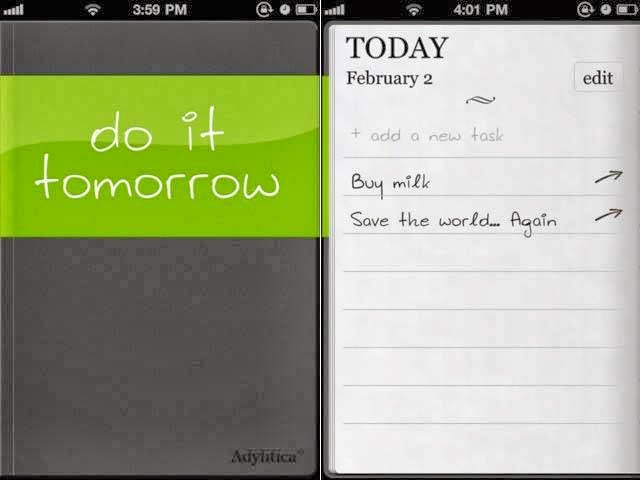
Sasha Cagen is the best known to-do-listologist. Her blog is full of lists which reveal so much about their writers. (http://www.todolistblog.com/Lists can be a precise diary of what we did, what we are planning to do and – maybe most often – of what we fail to do. There are a lot of items I have had on my lists for ages. At work these often are tasks that I do not particularly like, e.g. calculations or anything else involving maths and excel. Those two are my arch enemies, I try to hide from them as good as I can. And I am an expert at procrastination, in private those things, wandering on every list are either also involving maths (like figuring out a private form of pension) or take some effort or organizing (like taking part in a burlesque seminar, or learning Italian – I started this, though. Yay for me!) I even have an app on my phone called “do it
"Do it tomorrow"-app
tomorrow”, created for procrastinators like me. Here I write down every single thing I want to remember, it is my virtual knot in a tissue (is that an international habit? In German culture you used to do that if you had something to remember.) Sometimes stuff I have to do for work pop into my head in the middle of the night. And while I used to lie awake and think about it, nowadays I just write it down into my phone and get to it in the morning. (Also I use it to write down every musician or song I hear somewhere and want to check out later on spotify. Great, because now I never feel like I am missing something that might be as life-changing as a favourite new song or singer.)
I love crossing out items on to-do lists. I always make sure to write down even tiny tasks, just to make sure I have short-term successes. Fooling oneself and yet it works pretty well. (The above mentioned app actually has this feature. You can virtually cross out your tasks, great!)

My hitlist of lists (I just love lists):

1. work to-dos (always several at the same time)
2. shopping lists (handy to keep you from buying half the supermarket)
3. pack-list for holidays (reusable)
4. invitation lists (sometimes virtual on facebook, sometimes on paper)
5. goals (usually appears in January)

There is a special kind of list I rarely make, which is a “grateful-for-list”. Psychologists say that these kinds of lists instantly make you feel better, because they help you to focus on great stuff happening in your life. So I decided it is time I write a “grateful-for-list” and here it is:

Things I am grateful for:

1. my smart, funny and loving boyfriend
2. friends
3. family (they have always been there for me which I cannot appreciate enough, knowing they are there feels like a safety net to me)
4. health (apart from my migraines I am a pretty healthy lass)
5. job ( I am doing what I like and am as free as a bird doing it. Plus I love the creative atmosphere of working at university.)
6. DIY (the whole movement tends to give me some hope that mankind is not completely lost plus: it is fun!)
7. Nature (making me feel tiny and grateful everyday. The power a beautiful sunrise or a clearblue sky have over people is magical.)
8. Internet (it might be weird that I am grateful for the internet, but my life would be so different without it. There is so many people in my life I wouldn't have met, including my better half (we met on a party, organised in the net, by couchsurfers, also something I am grateful for) and also detecting new hobbies via the net is a great experience, like blogging or knitting, for example.
9. choices (I did the right thing, studying media science, chose the right job, chose the right place to be with great people, alhtough this seems to be a bit of a repetition)

I bet there are loads of things I have forgotten or I can write down in future. Things I am grateful for might change through time as well. we will see....

Make a list and you will see, you feel better the instant you are finished with it.

Tuesday, March 25, 2014

The WHO puts us all on a sugar-diet!


I have the feeling that my obsession with sugar – on the one hand craving it and at the same time trying to find out how bad it really is for my body – follows a trend that will hit us hard in the next couple of years, maybe even already in the next months. Dr. Robert Lustig is quoted more and more throughout the media, new studies are being made and finally, one big change just occurred a few days ago:
The WHO changed its recommendation concerning sugar! This is huge, people. All those last forty years, when obesity became a problem in the US and politicians requested scientists to solve the problem, sugar has been ignored and fat has been blamed. Why?
This might sound a bit like a conspiracy-theory, but it is a plausible explanation: the sugar lobby is just too big. They pump a lot of money into the government, also into science, and it is no surprise that they saw the introduction of low-fat products as their chance to sell even more sugar and make people therefore more addicted to their products. This is exactly how it worked: fat was reduced in a lot of products, (low-fat yogurt, butter, cheese, there is even low fat lasagne, tiramisu, toffees, etc.) but as fat improves taste, you had to add sugar to compensate for the missing fat. This had two effects: 1st the body does not feel as full as with the full-fat version, craves more in consequence and 2nd the sugar triggers the reward centre of the brain and makes us want more. We can see the result on the streets in everyday life and on ourselves: we get fatter inspite of all the low-fat products. Scientists have criticised the food industry ever since. Check out this BBC documentary, it shows pretty accurately on how the whole process works.


Jacques Peretti gives a very good overview on what the problem with our everyday diet is. Robert Lustig too is interviewed in this documentary. (Lustig’s lecture on youtube got commented by a girl from the US “He is fat himself and shouldn’t lecture us.” (paraphrasing) Obviously, she hasn’t seen the video. Lustig is not lecturing anyone and least the obese people themselves. Plus, he admits that he loves sugar just like anyone else. Which is the curse of sugar: knowing how bad it is, does not help.) Peretti says that the American government and the WHO are dependent on the sugar lobby and will only change their recommendations for sugar once the costs for obesity rise higher than the money gained by the sugar industry. Money rules the world… This apparently is the case now, as the WHO announced new guidelines on sugar only a few days ago, reducing the amount of recommended sugar intake dramatically from 10% to only 5% of your daily calorie intake.

“For an adult at a normal body mass index, or BMI, eating 5% would be around 25g of sugar – or six teaspoons. That’s less than is typically found in a single can of regular soda, which contains about 40 grams of sugar.” (http://edition.cnn.com/2014/03/06/health/who-sugar-guidelines/


Things are about to change. And they have to, regarding the rising levels of obesity, the numbers of children suffering from type 2 diabetes and more and more people dying from metabolic syndrome. There are more people overweight than undernourished today, which seems like a joke.


How is my personal war on sugar going? Well, I have mentioned the fruit yogurt I couldn’t resist. Apart from that it is going pretty well. I learned that I should eat more regularly (which could also help me get rid of my migraine attacks.) and that it is much harder, to resist sweet food when I am stressed and everything seems to fall apart. But I managed and I am pretty optimistic of refraining from eating candy till Easter. Apparently though, sugar and especially chocolate is not a trigger for my migraine as I had more attacks already in March than I had in February. But that is a good thing, as I am only damaging my insulin- levels eating chocolate, not triggering any headaches. I also learnt that I cannot live without the taste of sweet food, not unless I move into a desert with no supermarkets and no fruit available.
So I eat plenty of fresh fruit but as Robert Lustig states the fiber from fresh fruit and veggies makes sugar much less dangerous, this is not really bad for you. Just leave away the juice and smoothies and eat the real thing. I also found a new love: sundried tomatoes. They are my candy now and I truly love them. So you can live without candy and it is not too hard, really. In the beginning of April I can donate blood again and I am pretty excited for the results of the blood test: will my no-sugar-diet have any affect on them?